
AI
AI Agents for Ecommerce: What They Actually Do With Your Product Data
Qooly AI EditorialOctober 31, 2026 · 5 min read

Two years ago, launching a product category meant a project plan, a data migration, and six weeks of lead time. Today the fastest teams do it in an afternoon, by describing what they need and reviewing what the AI built.
The bottleneck was never the decision. Deciding to launch 400 SKUs on a new marketplace takes a meeting. What took six weeks was the mechanics: mapping your attributes to the channel's taxonomy, reformatting titles to character limits, generating the missing bullet points, handling the 8% of products that don't fit the template. That work is exactly what AI is good at and humans are slow at.
Old:
New:
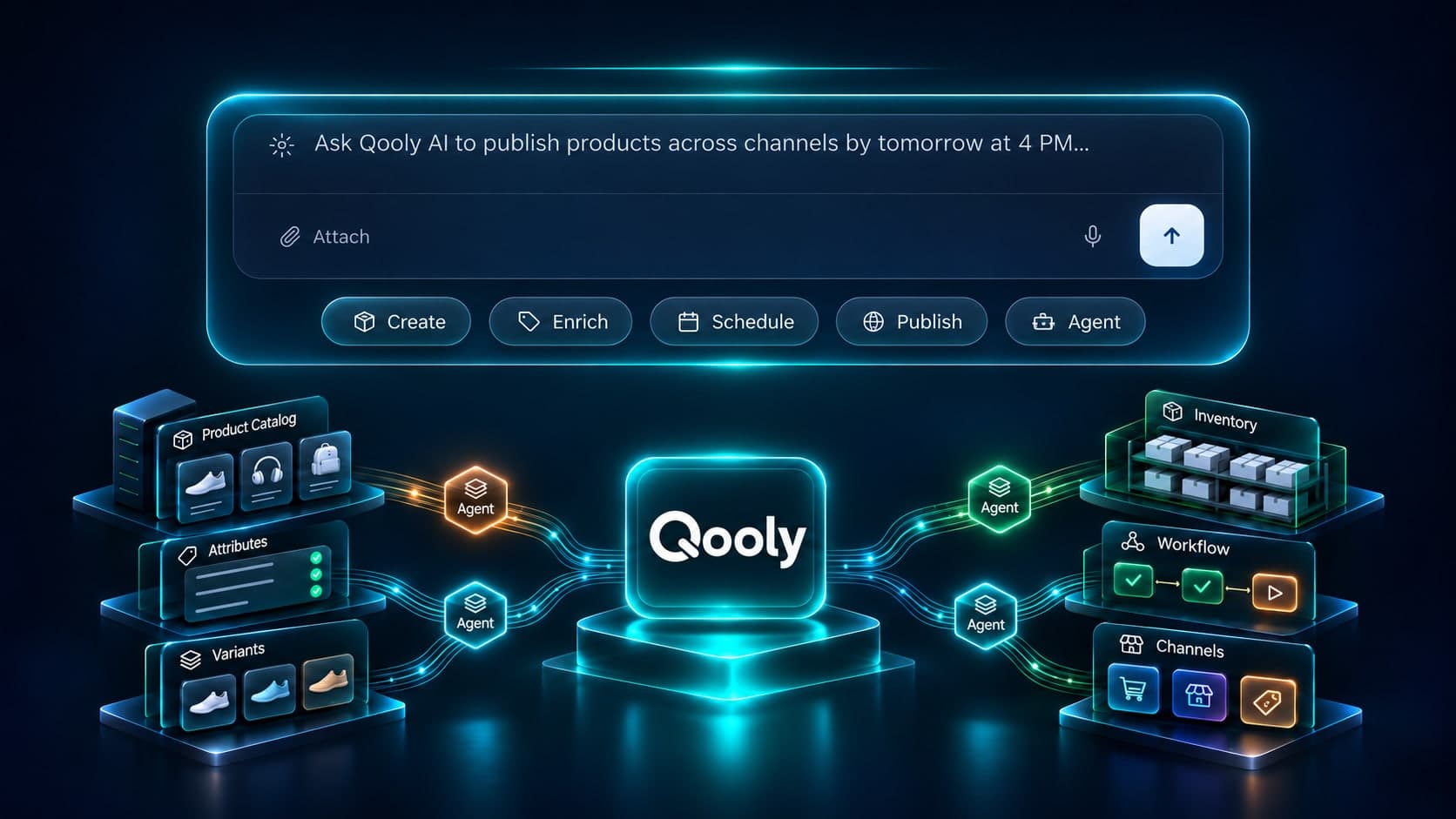
The step count isn't the point. The point is who does the mechanical work. In the old model, humans did the mapping and the machine did the moving. In the new model, that's inverted: the AI handles field mapping, enrichment, channel formatting, and syndication, while humans make the calls that actually need judgment: pricing, positioning, which SKUs to hold back.
A homeware brand with 2,300 SKUs decides to launch on a European marketplace. The channel wants EAN codes, metric dimensions, a 150-character title format, and a category tree that shares maybe 60% of its logic with the brand's own taxonomy.
The traditional version of this project: a mapping spreadsheet with 47 columns, three weeks of back-and-forth with the channel's onboarding team, and a first-pass rejection rate around 20%.
With Qooly, the brand connects the channel, and the AI reads the channel spec directly. It maps categories, converts inches to centimetres, restructures titles to the format, flags 140 SKUs missing EANs, and drafts the missing attribute values from product imagery and supplier data. The team reviews the flags, approves in bulk, and products are live the same day. First-pass rejection rate: under 2%.
A same-day launch isn't just six weeks of saved effort. It's six weeks of accumulated reviews, search ranking, and sales history your competitor doesn't have yet. Marketplace algorithms reward tenure and velocity. The listing that goes live in week one is still outranking the week-seven listing a year later.
And the capability compounds too. A team that can launch a channel in a day treats channel expansion as an experiment, not a capital project. Try the marketplace. If it does £30K a month, invest. If it doesn't, switch it off. The cost of being wrong drops to nearly zero, so you can afford to be wrong more often: which means you find the winners faster.
None of this works if the underlying catalog is a mess. Conversational launch is the visible layer; the thing that makes it possible is product data that's complete, validated, and structured enough for an AI to act on. Get that layer right and the six-week launch becomes an anachronism.
Keep reading