
Operations
The Product Intelligence Layer: The Missing Piece Between Your ERP and Every Channel
Qooly AI EditorialOctober 31, 2026 · 5 min read

Generating product content has become easy. Any team can produce a thousand descriptions in an afternoon. The hard question comes after: would you publish them to every channel, unread, under your brand?
For most teams the honest answer is no, and that's the right instinct. A wrong claim, an off-brand phrase, a missing safety attribute or a price below cost doesn't stay in a draft. It reaches customers, marketplaces and, increasingly, the AI assistants that repeat your product data back to shoppers.
The answer isn't less AI. It's governed AI: AI that works inside rules you define, with approvals where people need to decide and a record of everything it does.
Most AI content tools work on a prompt: describe the voice you want, generate, then have someone proofread. That model breaks at catalog scale:
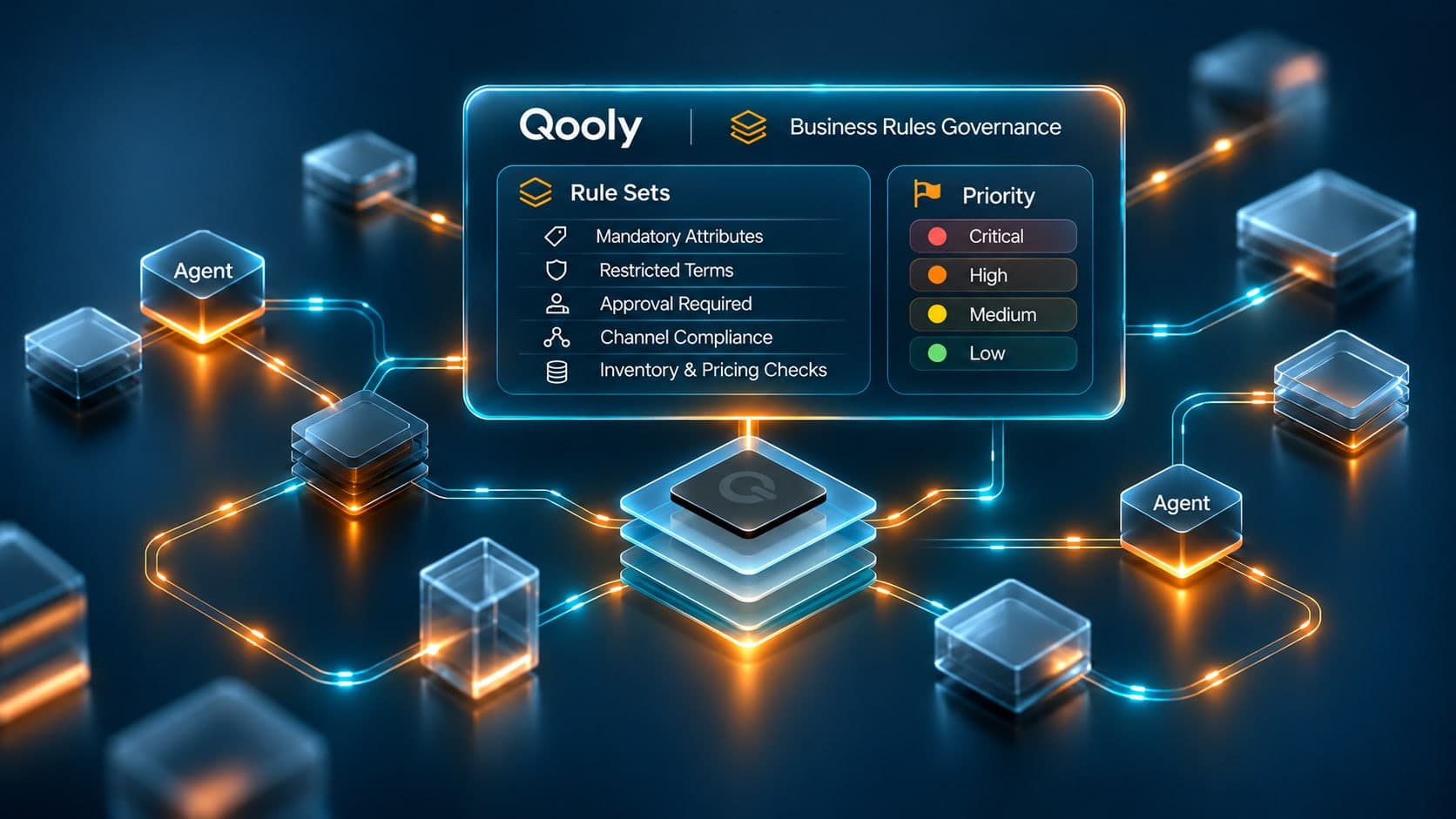
In Qooly AI, your business rules, such as required attributes, taxonomy, size conventions, media specifications, barcode validation and pricing rules, are checked on every write, whoever or whatever made the change. A value that breaks a rule is refused and held for review. It never reaches the channel and then waits to be noticed.
AI-written copy sounds generic when nothing constrains it. In Qooly AI your tone, your banned words and your claim boundaries are part of the product record's rules. A generation that breaks one is refused and held for review instead of being published and edited afterwards. Hand-written content you want to keep stays exactly as written; AI fills only the gaps you choose.
Enrichment is constrained to your trusted sources: your ERP, supplier data, spec sheets and governed attributes. Your rules decide which fields may be released automatically. Regulated language, compliance copy and brand claims route to a named approver before anything goes live.
Every change leaves a record of the input and the rule that produced it. Agent Price records the inputs behind every price, so any number can be explained later, and refuses outright to publish a price that would breach your margin floor. Agent Scheduler records what each campaign window changed, field by field, so closing it restores exactly what it touched.
It's tempting to see rules and approvals as friction. In practice they're what let AI move at full speed:
Shoppers increasingly ask AI assistants about products instead of searching. Those assistants read structured product data, which means what they say about your products is only as accurate as the data you publish. Governed product data, published from one validated record to every channel and assistant, is how you keep that answer right. We explore this further in answer engine optimization.
Governance also means protecting the data itself. In Qooly AI data is encrypted in transit and at rest, access is role-based, and the platform is aligned to ISO 27001.
Governed AI means AI works inside rules you define. Every generated or changed value is checked against your business rules and each channel's requirements before it can publish, sensitive content waits for a named approver, and every change keeps a record of its input and the rule that produced it.
Not when brand voice is a rule rather than a prompt. In Qooly AI your tone, banned words and claim boundaries are part of the product record's rules, and a generation that breaks one is refused and held for review instead of being published.
Yes. Hand-written content stays exactly as written. AI fills the gaps you choose, and your rules decide which fields may be released automatically and which need review.
Data is encrypted in transit and at rest, with role-based access controls and strict data-handling practices. Qooly AI is aligned to ISO 27001. Talk to the team for details, or see it with your own data.
Keep reading