AI
AI Agents for Ecommerce: What They Actually Do With Your Product Data

Qooly AI EditorialOctober 31, 2026 · 5 min read

Shoppers now ask ChatGPT what to buy, and it answers with products: images, prices, comparisons and links to buy. For a retailer, the practical question is simple. When someone asks about a product you sell, is yours one of the products ChatGPT can show?
ChatGPT shopping also changed shape in 2026. This guide covers how it works as of November 2026, the routes in for different kinds of merchants, what OpenAI's product feed requires, and what you can fix in your catalog today, whichever route you use.
Discovery happens in ChatGPT, and checkout happens on your site. OpenAI says it is moving away from a standalone Instant Checkout experience and prioritising better shopping discovery and merchant-owned checkout. By default, shoppers are sent to your site or app to buy.
It is live in the US. OpenAI's merchant page says shopping is currently live for ChatGPT users in the U.S.
There are no fees on those sales. OpenAI says there are no fees for purchases made on your site or app.
Results are organic. OpenAI states that product results are selected independently by ChatGPT, are not ads, and are not influenced by its partnerships. Its help center says merchants are ranked on factors including availability, price, quality, and whether the merchant is the maker or primary seller of the product.
Ads exist, separately. OpenAI has started showing ads in ChatGPT, labelled as sponsored and run on separate systems from answers. Product feed campaigns for ads are a separate program from organic results.
| Route | Who it suits | Status, November 2026 |
|---|---|---|
| Your website, crawled | Any merchant | Works today. Allow OpenAI's OAI-SearchBot crawler. |
| Shopify | Stores that sell to US customers | Included by default through Shopify Catalog. |
| Etsy | Etsy sellers | Already integrated. No application needed. |
| Direct product feed | Other brands and retailers | Apply at chatgpt.com/merchants. Limited to approved partners, with a waitlist. |
You don't need a feed to appear. ChatGPT can use information it crawls from your site. The crawler that matters is OAI-SearchBot. Sites that block it are not shown in ChatGPT search answers, though they can still appear as plain navigational links. OpenAI says robots.txt changes take about 24 hours to take effect. Blocking GPTBot, OpenAI's training crawler, is a separate choice and doesn't affect search.
The ChatGPT channel is active by default for eligible Shopify stores, through Shopify Catalog, and checkout sends shoppers to your store. Your store must sell to customers in the United States, though it can be based elsewhere. B2B-only products aren't supported. If you turn Catalog access off, Shopify says it can take up to 7 days for your products to stop being shared. Shopify also offers an Agentic plan that lets brands not on Shopify list products in Shopify Catalog.
Etsy's catalog is already integrated with ChatGPT, so Etsy sellers need no extra setup.
Everyone else applies through chatgpt.com/merchants, which asks for your country, category, catalog size and feed readiness. Feed onboarding is currently limited to approved partners, and applicants join a waitlist. OpenAI says it is building a self-serve merchant platform for later this year.
Some categories are excluded, including adult content, age-restricted products such as alcohol and nicotine, gambling, weapons, prescription-only medicines and unlicensed financial products.
If you are approved, the feed works like this:
Nine fields are required for every product:
| Field | What it holds |
|---|---|
item_id | Your unique product ID |
title | Product title |
description | Product description |
url | Product page link |
brand | Brand as shown on the product page |
seller_name | Who sells this offer |
image_url | Main image |
availability | In stock, out of stock, pre-order, backorder or unknown |
price | Price with currency |
Variants also need group_id and listing_has_variations, so sizes and colours are grouped under one listing. Optional fields cover what shoppers compare: gtin, mpn, color, size, material, dimensions, weight, extra images, sale price, shipping, return policy, review counts and star ratings. OpenAI's documentation says recommended attributes, such as rich media, reviews and performance signals, improve ranking, relevance and user trust.
Two settings are worth knowing. is_eligible_search is on by default. is_eligible_checkout is separate and needs its own integration. In-chat checkout runs on the Agentic Commerce Protocol, an open standard from OpenAI and Stripe, and OpenAI is not the merchant of record: you keep the customer and handle payment through your own payment provider.
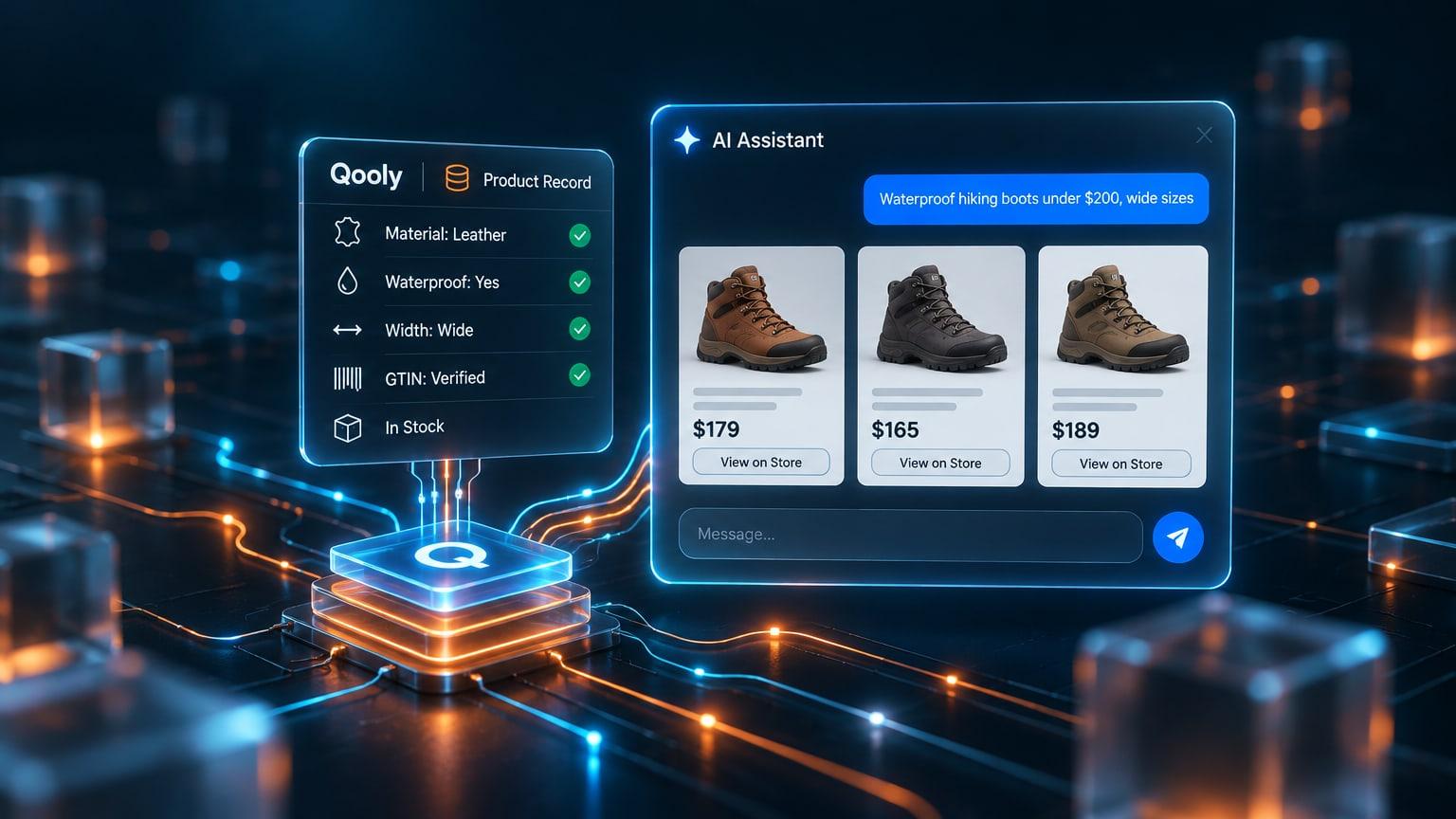
Whichever route you take, ChatGPT can only describe what your data says. A product with no material, no dimensions and no identifier is hard to recommend for a specific question, because there is nothing to match the question against.
OpenAI doesn't document schema.org markup as a ranking factor. Even so, accurate Product markup on your pages is the simplest way to keep what a crawler reads in line with what your feed says.
The work above is the same work every channel needs, done one more time with stricter consequences. Qooly AI's OpenAI connector keeps one governed product record: Agent Flow fills the attributes and descriptions shoppers ask about, identifiers are validated before anything publishes, and price and availability changes reach your storefront and feeds as they happen. The same record serves Google Shopping, Amazon and TikTok Shop. For the wider shift, read our guide to answer engine optimization.
There are four routes. ChatGPT can find products by crawling your site if you allow OpenAI's OAI-SearchBot. Shopify stores that sell to US customers are included through Shopify Catalog by default. Etsy's catalog is already integrated. Other merchants can apply at chatgpt.com/merchants to send a product feed, which is currently limited to approved partners.
OpenAI says there are no fees for purchases made on your site or app when a shopper finds the product in ChatGPT. Advertising in ChatGPT is a separate, paid product.
OpenAI says it is moving away from a standalone Instant Checkout experience and prioritising discovery, with checkout on the merchant's own site or app by default. In-chat checkout through the Agentic Commerce Protocol remains documented for approved partners.
No. ChatGPT can use information it crawls from your site. OpenAI says a feed gives you greater control over how your products appear and helps keep the information accurate and current.
No. OpenAI states that product results are selected independently and are not ads. Ads in ChatGPT run separately, are labelled as sponsored and don't change how answers are ranked. See how Qooly AI keeps your catalog ready for AI assistants.
Keep reading